Quick answer: Retatrutide has produced greater average weight reductions in its own clinical trials than semaglutide has in several major semaglutide trials, but the drugs have not been directly compared in a head-to-head obesity trial. Semaglutide is FDA-approved and commercially available; retatrutide remains investigational and is not FDA-approved.
Retatrutide and semaglutide are two medications frequently compared in discussions about medical weight management. Semaglutide is an established GLP-1 medication with FDA-approved options for chronic weight management, while retatrutide is an investigational triple-receptor agonist that has produced substantial weight reduction in Phase 3 clinical trials.
The most important distinction is not simply which medication produced the larger percentage of weight loss in a study. Retatrutide and semaglutide differ in how they work, how mature their clinical evidence is, their FDA approval status, and whether they can currently be prescribed as approved obesity treatments.
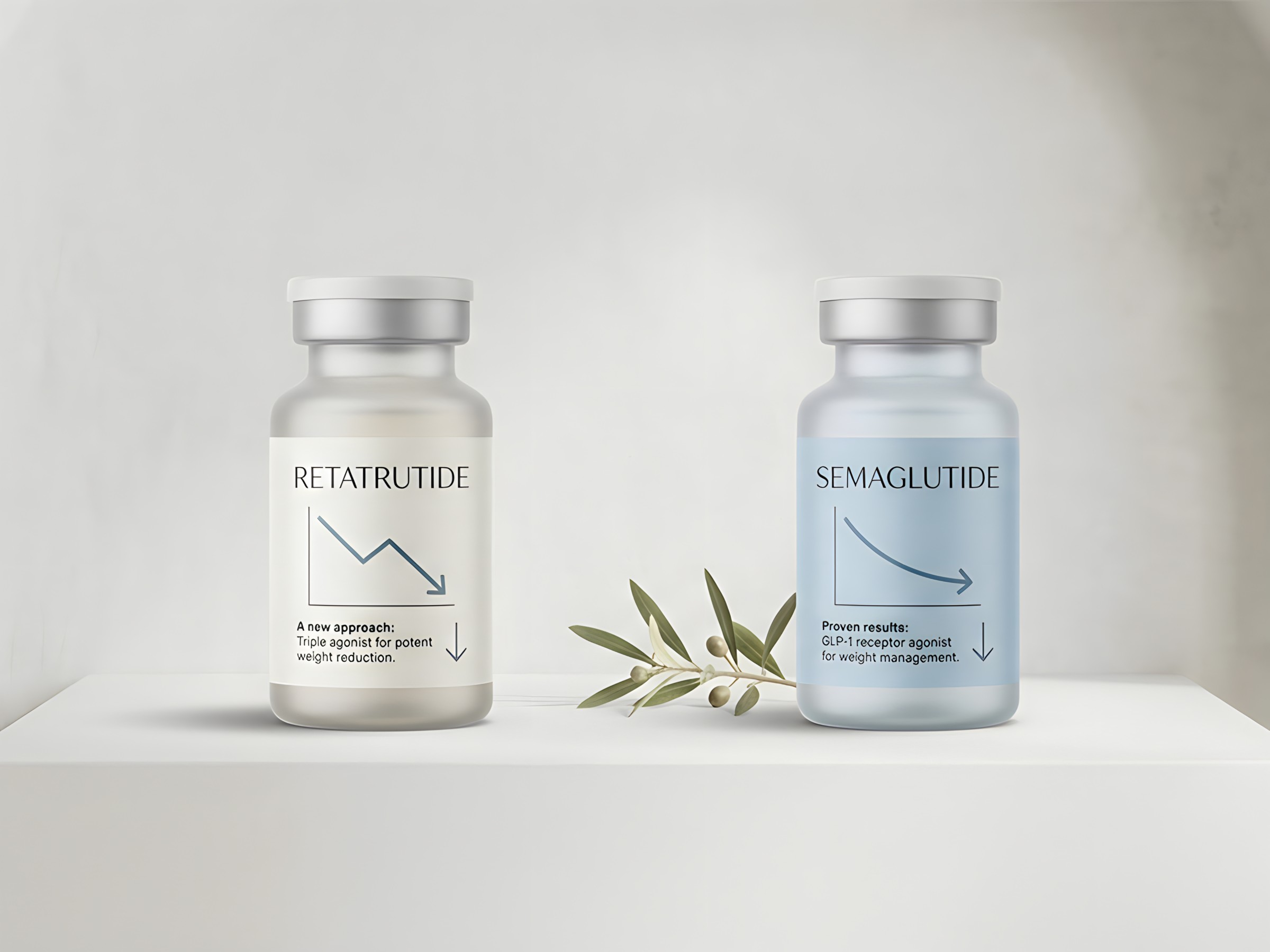
Retatrutide vs. Semaglutide at a Glance
| Feature | Retatrutide | Semaglutide |
|---|---|---|
| How It Works | Activates GLP-1, GIP, and glucagon receptors | Activates GLP-1 receptors |
| FDA status | Investigational; not FDA-approved | FDA-approved for chronic weight management as Wegovy |
| Clinical evidence | Phase 3 trial results are now available | Extensive Phase 3 and post-approval evidence |
| Selected weight-loss result | 28.3% average reduction at 80 weeks with 12 mg in TRIUMPH-1 | 14.9% average reduction at 68 weeks with semaglutide 2.4 mg in STEP 1; higher-dose Wegovy HD was approved in 2026 |
| Availability | Clinical development/trials; not an approved prescription treatment | Available by prescription for appropriate patients |
| Common adverse events | Gastrointestinal events have been common in trials | Gastrointestinal adverse effects are common, particularly during dose escalation |
Important: These weight-loss percentages come from separate clinical trials with different study designs, doses, populations, and treatment durations. They should not be interpreted as a direct measure of how much more effective one drug is than the other.
Why Retatrutide and Semaglutide Are Being Compared
The medical weight loss landscape has evolved rapidly. Semaglutide established itself as one of the most extensively studied GLP-1 receptor agonists used in weight management, with data from multiple large-scale clinical trials supporting its efficacy and safety profile.
How Semaglutide Works for Weight Loss and Metabolic Health
Semaglutide is a GLP-1 receptor agonist that mimics glucagon-like peptide-1, a naturally occurring hormone central to appetite regulation, insulin secretion, and gastric motility. By activating GLP-1 receptors, semaglutide reduces appetite, delays gastric emptying, and increases glucose-dependent insulin secretion, contributing to weight reduction and improved glycemic control in appropriate patients.
Semaglutide 2.4 mg produced an average body-weight reduction of approximately 14.9% at 68 weeks in the STEP 1 trial. The evidence base has continued to evolve: in March 2026, the FDA also approved Wegovy HD, a 7.2 mg semaglutide dose for certain adults with obesity or overweight, after clinical data showed greater average weight reduction than the previously approved dose.
Semaglutide is FDA-approved for chronic weight management under the Wegovy brand for eligible patients, with an extensive clinical evidence base that includes the STEP program and subsequent studies.
Clinical monitoring during dose escalation can help identify tolerability issues and determine whether treatment adjustments are appropriate.
Start Your Journey to Success, Don’t Wait Any Longer!
Join our satisfied clients who’ve experienced safe, effective treatments.
How Retatrutide Works and What Makes It Different
Retatrutide represents a more expansive pharmacological approach. While semaglutide targets a single receptor and tirzepatide targets two, retatrutide is a triple agonist, simultaneously activating GLP-1, GIP, and glucagon receptors. Researchers are studying whether combining these three receptor pathways can influence appetite, glucose regulation, and energy expenditure in ways that differ from single- or dual-receptor therapies.

The inclusion of glucagon receptor agonism is one of retatrutide’s defining distinctions. Researchers believe this pathway may influence energy expenditure and other aspects of metabolic regulation when combined with GLP-1 and GIP receptor activity. Early Phase 2 findings were followed by positive topline Phase 3 results reported by Lilly: in TRIUMPH-1, the 12 mg dose produced an average 28.3% body-weight reduction at 80 weeks, with 30.3% reported at 104 weeks in a prespecified extension involving participants with a baseline BMI of at least 35.
It is essential to note that retatrutide remains an investigational drug. It has not received FDA approval, even though Phase 3 trial results are now available. Its long-term post-approval safety and real-world effectiveness therefore cannot yet be evaluated in the same way as semaglutide’s.
Retatrutide should not be presented as a currently available alternative to FDA-approved obesity medications.
Retatrutide vs. Semaglutide Weight Loss Results
Both drugs have produced substantial average weight reductions in clinical research, but their results should not be compared as though they came from the same study. Semaglutide 2.4 mg produced a 14.9% average reduction at 68 weeks in STEP 1, while retatrutide 12 mg produced a 28.3% average reduction at 80 weeks in TRIUMPH-1. These were separate trials with different designs and populations, so the percentages do not establish that retatrutide is a specific amount more effective than semaglutide.
| Study | Drug/dose | Duration | Average weight reduction |
|---|---|---|---|
| STEP 1 | Semaglutide 2.4 mg | 68 weeks | 14.9% |
| TRIUMPH-1 | Retatrutide 12 mg | 80 weeks | 28.3% |
These are cross-trial figures and should not be interpreted as a head-to-head efficacy comparison.
Side Effects, Safety, and Treatment Considerations
Semaglutide and retatrutide have both been associated with gastrointestinal adverse events, including nausea, vomiting, diarrhea, constipation, and abdominal symptoms. However, their safety evidence should not be treated as equivalent because semaglutide has a much larger approved-use and long-term evidence base.
Semaglutide should be prescribed and monitored by an appropriate clinician. Retatrutide remains investigational and is being studied in clinical trials rather than used as an FDA-approved obesity treatment.
The critical distinction from a treatment standpoint is availability. Semaglutide can be prescribed, monitored, and adjusted within a clinical setting today. Retatrutide, as an investigational drug, is not an FDA-approved prescription treatment. For patients using FDA-approved obesity pharmacotherapy, nutrition, physical activity, sleep, behavioral support, and ongoing medical care remain important components of long-term weight management.
Frequently Asked Questions About Retatrutide vs Semaglutide
Choosing a Medical Weight Management Approach
Selecting an appropriate weight-management treatment requires clinical assessment rather than choosing a medication solely because it produced a larger average percentage of weight loss in a trial. At BODYWELLE, we evaluate each patient’s health history, metabolic health, laboratory results when clinically appropriate, treatment goals, and other relevant factors before recommending a course of care.
Whether semaglutide is the right fit for your current needs or you are interested in understanding what emerging therapies may offer, the process begins with a comprehensive consultation.
Schedule your consultation at BODYWELLE in Miami Beach to discuss currently available medical weight-management options and an individualized treatment plan.